
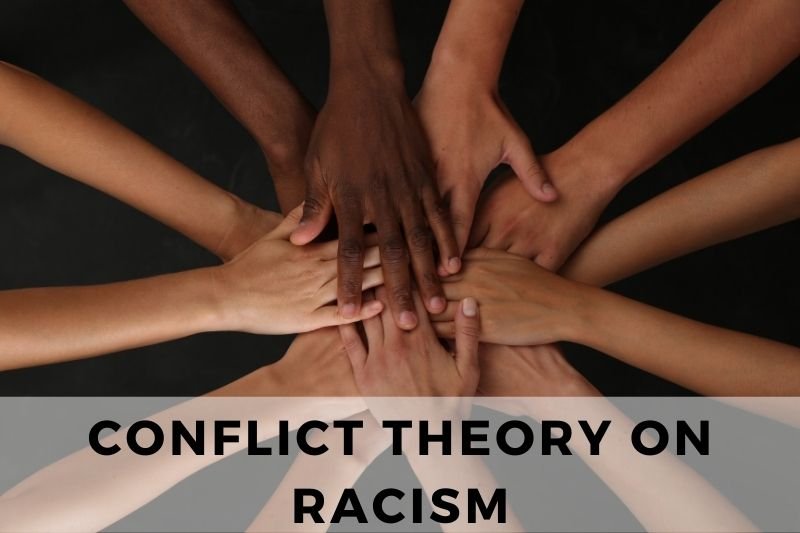
Why does racial inequality persist in society? Conflict theory explains racism as a struggle for power and resources between dominant and marginalized groups. It views racism as a product of competition, economic exploitation, and institutional control. This theory, rooted in Karl Marx’s ideas, argues that social structures favor the powerful while oppressing others.
It highlights systemic discrimination in wealth, education, and legal systems. By understanding these power struggles, we can analyze racial inequality more critically. Conflict theory also explores how marginalized groups resist oppression and push for social change. This perspective helps explain racism’s deep impact on society.
Introducing Conflict Theory
Defining Conflict Theory
Conflict theory is a sociological perspective that sees society as an arena of inequality that generates conflict and social change. It suggests that social structures are shaped by struggles between groups over limited resources like power, wealth, and status. In the context of racism, this theory posits that racial inequality exists because dominant groups use their power to maintain control over marginalized racial communities. This view contrasts with functionalist theories, which argue that social stability is maintained through cooperation and consensus.
Conflict theory challenges the idea that society functions harmoniously. It focuses on how inequalities—especially in race, class, and power—fuel social unrest. In terms of racism, conflict theory argues that the status quo is preserved by those in power, who prevent equal access to resources for racial minorities. This results in persistent disparities in areas such as employment, education, and healthcare.
Origins of Conflict Theory
Conflict theory originated with the work of Karl Marx in the 19th century. Marx focused on the economic struggles between the bourgeoisie (owners of production) and the proletariat (working class). He argued that the economic system shaped all aspects of society, including politics, culture, and law. Marx’s ideas were expanded by later theorists who applied his concept of class struggle to other forms of inequality, including racial oppression.
In the early 20th century, scholars like Max Weber and W.E.B. Du Bois built on Marx’s theories, incorporating other factors like race, ethnicity, and power. Du Bois, for example, used conflict theory to explain the systemic racism faced by Black Americans in the United States. Today, conflict theory is used to understand how racial inequality is perpetuated through structures of power, both economic and institutional. It reveals how racism is not an isolated problem but a product of broader social conflicts.
Core Concepts of Conflict Theory
Conflict theory identifies several key concepts that explain how societal inequalities develop and persist. These concepts include:
#1. Power Dynamics
Power dynamics refer to the ways in which different groups control resources and influence decision-making. In the context of racism, dominant racial groups hold the power to shape laws, media representations, and economic systems. These power dynamics lead to racial discrimination, as minority groups often lack the resources to challenge these structures. By maintaining power, dominant groups ensure that their interests are prioritized while racial minorities are marginalized.
#2. Social Inequality
Social inequality describes the uneven distribution of resources and opportunities among different groups. Racism perpetuates inequality by denying minority groups equal access to education, jobs, healthcare, and political representation. This unequal distribution of resources creates long-term disadvantages for racial minorities. It also leads to disparities in wealth, which further entrench social and economic divisions.
#3. Class Struggle
Class struggle is the conflict between different social classes over access to resources. In terms of racism, the ruling class often includes racial groups that hold power over working-class or lower-income racial minorities. Class and race are often intertwined, with economic disadvantage reinforcing racial oppression. As a result, people of color are more likely to experience poverty, unemployment, and limited opportunities for upward mobility.
#4. Economic Exploitation
Economic exploitation occurs when one group takes advantage of another group’s labor or resources. In the case of racism, economic exploitation often involves the use of cheap labor from racial minorities or the extraction of resources from their communities. Historical examples include slavery, where Black people were forced into labor, and the exploitation of immigrant workers in industries like agriculture and construction. This exploitation perpetuates economic disparities between racial groups.
#5. Institutional Conflict
Institutional conflict refers to the ways in which systems like law, education, and healthcare enforce and reproduce inequality. Racism becomes institutionalized when these systems disproportionately affect racial minorities. For example, discriminatory laws, such as the Jim Crow laws in the U.S., have historically reinforced racial segregation. Even today, institutions may perpetuate racial inequality through biased policing, hiring practices, or educational disparities.
#6. Ideological Hegemony
Ideological hegemony is the dominance of certain beliefs or values that support the interests of the ruling group. In the context of racism, hegemonic ideologies often promote the superiority of certain races over others. These ideologies are reinforced through media, education, and political discourse. They create a narrative that justifies unequal treatment, making racism seem natural or inevitable rather than a result of social and political choices.
#7. Resource Distribution
The distribution of resources—whether wealth, land, or power—plays a central role in conflict theory. Inequitable resource distribution often results in racial disparities, with dominant groups controlling the majority of resources. For instance, wealth inequality between racial groups is one of the most enduring forms of racial conflict. Unequal access to resources reinforces systemic oppression, creating cycles of poverty and disenfranchisement for marginalized racial communities.
#8. Group Interests
Group interests refer to the specific needs and goals of different social groups, often driven by their position in society. In racial conflicts, the interests of dominant racial groups are often centered on maintaining their status and privileges. Meanwhile, marginalized racial groups fight for equal rights, representation, and resources. The clash of these interests drives much of the conflict surrounding racism, with power struggles taking place on both local and global scales.
#9. Social Change
Social change refers to the ways societies evolve in response to shifts in power, resources, and ideologies. Conflict theory posits that social change occurs through conflict, as oppressed groups challenge existing power structures. In the case of racism, social movements like the Civil Rights Movement in the U.S. and anti-apartheid efforts in South Africa have led to significant changes in the laws and social norms governing race relations. These movements highlight the role of resistance in challenging racial inequality.
#10. Conflict Resolution
Conflict resolution involves efforts to address and mitigate societal tensions through negotiation, compromise, or reform. While conflict theory emphasizes the inevitability of social conflict, it also recognizes that resolutions can occur through collective action and policy changes. Addressing racism through conflict resolution might involve dismantling institutionalized systems of discrimination, promoting diversity, and enacting laws that protect racial equality. However, true resolution requires sustained efforts to challenge deeply entrenched power structures.
The Conflict Theory on Racism and Its Impact
Power Dynamics and Racial Inequality
Power dynamics play a central role in the persistence of racial inequality. In societies where certain racial groups hold political, economic, or cultural power, they can shape laws and institutions to maintain their dominance. For example, in the United States, the power structure historically favored white Americans, enforcing segregation and disenfranchisement of Black Americans through policies like Jim Crow laws. These laws prevented equal access to education, housing, and voting for Black people, maintaining a racial hierarchy. The powerful groups’ ability to control resources directly influences how racial inequality is perpetuated, keeping marginalized groups in subordinate positions.
These power dynamics are not limited to legal structures but extend to cultural and social realms. Media representations, education systems, and employment practices all reflect the interests of dominant groups. For instance, the portrayal of racial minorities in negative or stereotypical ways helps reinforce public perceptions that support discriminatory policies and attitudes. By controlling narratives, dominant racial groups sustain power, limiting social mobility and reinforcing racial inequality. Thus, power dynamics are a crucial aspect of how racism operates in a society, shaping both individual opportunities and broader social structures.
Economic Factors in Racial Conflict
Economic factors are closely tied to racial conflict, with marginalized racial groups often subjected to economic exploitation. Historically, many racial minorities, such as African Americans and Indigenous peoples, have been denied access to wealth and economic opportunities. Slavery, for example, was not just a social system but also an economic system designed to benefit white slaveowners by using Black labor for free. Even after the abolition of slavery, economic disparities between races remained, with Black communities frequently excluded from owning property, starting businesses, or accessing quality education. This economic marginalization directly contributes to persistent racial inequality.
The economic disparities that exist today are a direct result of these historical injustices. Racial minorities often find themselves at a disadvantage in the job market due to discriminatory hiring practices, wage gaps, and lack of access to professional networks. The economic system in many countries continues to benefit those who have historical advantages, primarily white populations, while leaving racial minorities with fewer opportunities for wealth accumulation. Thus, economic factors are key to understanding how racial conflicts are perpetuated and how racism sustains social inequality.
Social Stratification and Racism
Social stratification refers to the hierarchical arrangement of individuals into different social classes, with racial groups often disproportionately placed at the lower levels. This system of stratification reinforces racial inequality by limiting access to resources such as education, healthcare, and housing for marginalized racial groups. For example, racial minorities often live in impoverished areas with fewer economic opportunities, lower-quality schools, and limited healthcare access. The effects of this stratification are far-reaching, perpetuating cycles of poverty that are hard to break, even across generations. Social mobility becomes restricted, particularly when systemic racism is embedded in institutional structures like the housing market or the criminal justice system.
Social stratification also contributes to the persistence of racist ideologies, as people in higher social strata may view themselves as more deserving of their privileges, while stereotyping those in lower strata. This division creates a sense of “otherness,” making it easier for individuals to justify discriminatory attitudes and behaviors. For instance, in many countries, wealth and race are intertwined, with white individuals historically having better access to resources. This connection between race and class perpetuates social stratification, further entrenching racial inequalities and fueling tensions between different racial groups.
Institutional Racism and Conflict Theory
Institutional racism refers to the systematic discrimination against certain racial groups through established institutions, such as the legal system, education, healthcare, and employment. This form of racism operates through policies, practices, and procedures that disproportionately disadvantage racial minorities, often without the need for overt racial animus. For example, studies have shown that Black Americans are more likely to be incarcerated than white Americans for the same offenses, reflecting racial biases within the criminal justice system. These institutional practices reinforce racial inequality by ensuring that certain groups have limited access to social mobility and opportunities for success.
The impact of institutional racism is felt in nearly every aspect of society, from education to healthcare to employment. Racial minorities are often subject to lower-quality schooling, inadequate healthcare, and biased hiring practices. In schools, Black and Latino students are more likely to face disciplinary action than their white counterparts, a pattern that can negatively affect their academic performance and future opportunities. In the workplace, racial minorities face barriers to employment and promotions, with research showing that resumes with “ethnic-sounding” names are less likely to receive callbacks. Institutional racism helps maintain power structures that benefit dominant racial groups while systematically disadvantaging marginalized ones.
Resistance and Social Movements
Resistance to racism often arises through social movements that challenge the status quo and demand racial equality. Movements like the Civil Rights Movement in the United States or the Anti-Apartheid Movement in South Africa exemplify how marginalized racial groups can organize and push for systemic change. These movements use various forms of resistance, including protests, legal challenges, and political activism, to expose the inequalities and injustices created by racism. By mobilizing individuals and communities, social movements aim to disrupt existing power dynamics and advocate for laws and policies that promote racial equality.
Social movements are essential in highlighting the effects of institutional racism and galvanizing support for change. For example, the Black Lives Matter movement has brought attention to police brutality and racial discrimination in law enforcement, leading to reforms and changes in public policies. These movements also provide a platform for marginalized communities to assert their rights and demand justice. Resistance, therefore, is a key element in conflict theory, as it highlights the ways in which oppressed groups can challenge racial inequality and work toward social transformation.
Intersectionality in Racial Conflicts
Intersectionality is a concept that explains how various forms of oppression, including racism, sexism, classism, and others, intersect and compound one another, creating unique experiences of discrimination for individuals. In racial conflicts, intersectionality helps to understand how race interacts with other social identities, such as gender, class, and sexuality, to shape the experiences of individuals. For example, a Black woman may face both racial and gender discrimination, which cannot be understood separately. Intersectionality underscores the need to recognize the complex and layered nature of oppression, acknowledging that experiences of racism are not uniform but are shaped by other social factors.
The intersectionality of race and other forms of discrimination is evident in many social issues, from employment discrimination to healthcare disparities. For instance, Black women are more likely to die during childbirth than white women due to a combination of racial prejudice and gender bias in the healthcare system. Similarly, working-class racial minorities may experience both racial and economic discrimination, making it harder for them to access education and career opportunities. Intersectionality thus provides a more comprehensive understanding of racism, showing that racial conflicts cannot be fully understood without considering the broader social and economic systems in which they exist.
Closing Thoughts
Conflict theory offers a powerful lens through which we can examine the root causes of racism and its impact on society. By highlighting the power dynamics, economic factors, and institutional structures that perpetuate racial inequality, it encourages us to critically assess the systems that maintain these disparities.
While the road to racial equality is complex and ongoing, understanding the core principles of conflict theory helps frame the struggle for racial justice. Social movements and resistance continue to play a pivotal role in challenging these structures and working toward a more equitable and just society for all racial groups.